Tell us about the job
Takes about a minute. No obligation.
A contractor quoting a boiler repair in Franklin County has to work out what actually wore the system down before they can price it accurately. 121 severe weather events were recorded in Franklin County, Illinois between 2015 and 2024. At roughly the national median, that record means severe weather is a real presence in this area, but it does not explain most failures on its own. Aging heat exchangers, neglected burners, and deferred service are what a contractor finds most often when a boiler stops working here, and the repair scope follows from those findings.
A boiler in housing built this long ago has usually been through more than one set of hands. Half the homes in Franklin County, Illinois were built in 1963 or earlier (2020-2024 ACS 5-year). That history shows up once the unit is open: mixed-generation parts, previous repairs that worked well enough to defer the next one, and components whose manufacturers have long since changed the part numbers or stopped making them entirely. What a contractor finds inside decides whether the job is a straightforward repair or a hunt for compatible replacements that still fit the system's connections and pressure ratings.
The Parts of a Boiler a Contractor Checks First
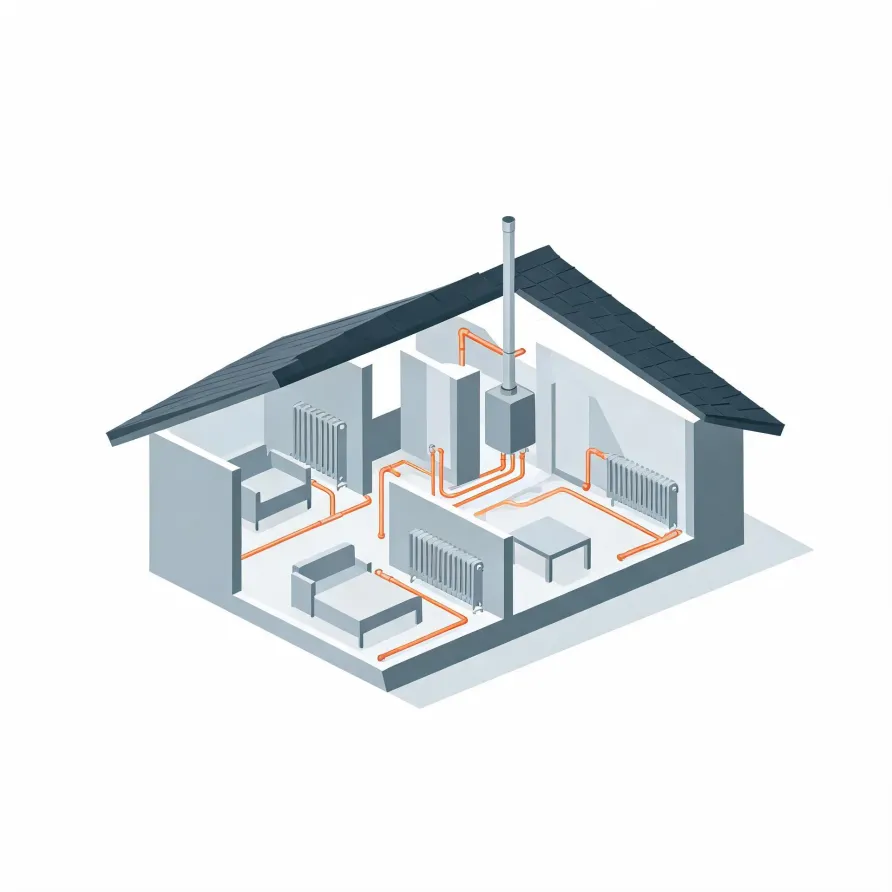
The boiler itself sits in the basement or mechanical room and is where water gets heated. When a boiler malfunctions, a contractor starts here, checking the heat exchanger, burner, and pressure vessel for cracks, corrosion, or combustion problems. The thermostat, mounted on a living-space wall, is the other early stop, since a faulty one can mimic a boiler failure.
Circulator pumps move heated water through the pipe runs to radiators or baseboard units in each room. When a room runs cold, the circulator serving that zone is a likely cause. The expansion tank, pressure relief valve, and zone valves each sit along those pipe runs, and any one of them can produce pressure faults, leaks, or uneven heat.
The drawing shows a general boiler layout, and a licensed contractor determines which components apply and what work is needed in your specific home.
Get matched in Franklin CountyFranklin County, by the numbers
121 severe weather events were recorded in Franklin County, Illinois between 2015 and 2024.
NOAA National Centers for Environmental Information, Storm Events Database, bulk CSV export, events 2015-01-01 through 2024-12-31.Half the homes in Franklin County, Illinois were built in 1963 or earlier (2020-2024 ACS 5-year).
U.S. Census Bureau, 2020-2024 American Community Survey 5-Year EstimatesFranklin County, Illinois holds 18,462 housing units (2020-2024 ACS 5-year).
U.S. Census Bureau, 2020-2024 American Community Survey 5-Year EstimatesOwners occupy 74.1% of the occupied homes in Franklin County, Illinois (2020-2024 ACS 5-year).
U.S. Census Bureau, 2020-2024 American Community Survey 5-Year EstimatesBoiler Repair Rules & Standards on Record for Franklin County, Illinois1 sourced rules and standards
Licensing and Legal Requirements in Franklin County, Illinois
Illinois leaves HVAC licensing to the municipality: state law lets the corporate authorities of each city or village examine, license and regulate heating, air conditioning and refrigeration contractors, and caps the licence fee they may charge at $50 — so who licenses you depends on the town you work in.
Severe Weather Events in Franklin County
Boilers in Franklin County work against whatever the climate puts on them, and that workload shows up in wear. A chart of recorded severe weather events gives local contractors the context they need to anticipate what repair histories here tend to look like.
121 severe weather events, 2015–2024. Source: NOAA National Centers for Environmental Information, Storm Events Database.