Tell us about the job
Takes about a minute. No obligation.
A boiler repair in DuPage County starts with what the system has already been carrying. 275 severe weather events were recorded in DuPage County, Illinois between 2015 and 2024. At that rate, severe weather is part of the normal operating life of a boiler here, not an occasional interruption to it. Contractors working repairs in this area check heat exchangers and pressure relief components early, because those are the parts that absorb sustained load over time. Age and maintenance history still matter, but the weather record in this county is real enough that a contractor who skips the load-bearing components first is skipping the wrong things.
Boilers in houses this old have rarely been touched only once. Half the homes in DuPage County, Illinois were built in 1978 or earlier (2020-2024 ACS 5-year). Successive repairs and replacements leave behind a system that reflects decisions made by contractors years or decades apart, and what a technician finds once the boiler is open may bear little resemblance to what was there originally. Heat exchangers, expansion tanks, and zone valves sourced from different eras often sit alongside each other, and the parts a current component requires may no longer be in production. That is what sets the scope of a boiler repair call here: not the age printed on the unit, but the condition of everything attached to it.
The Parts of a Boiler a Contractor Checks During Repair
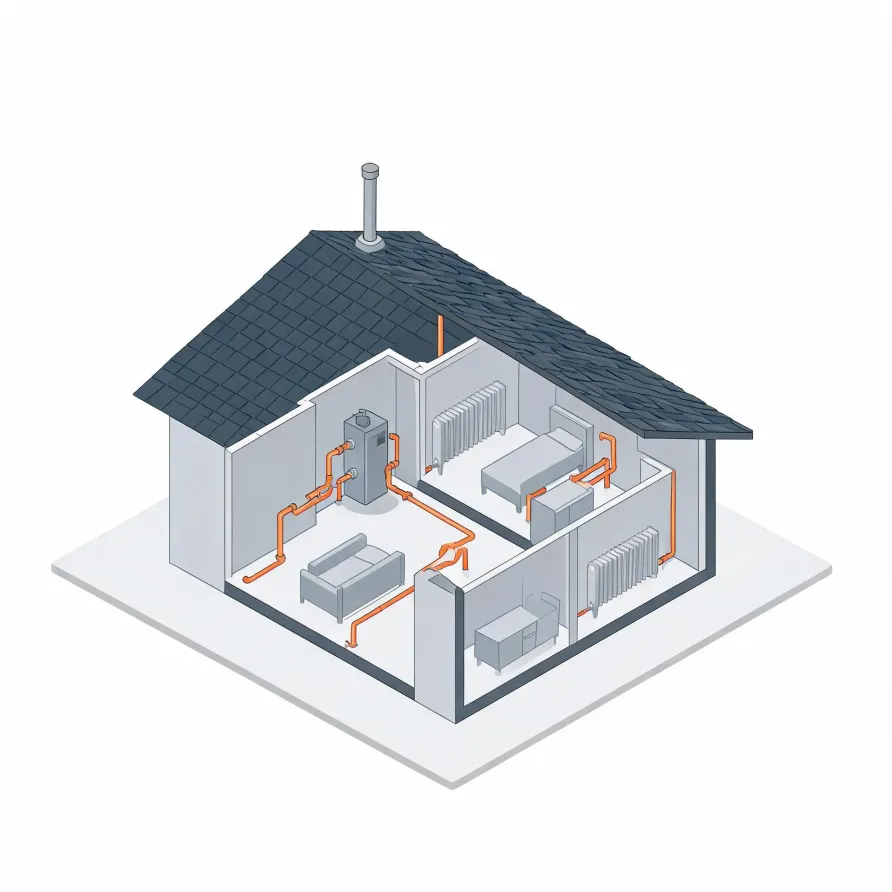
The boiler itself sits in the basement or a mechanical room and is where water gets heated. A contractor working a repair call looks here first: the burner, the heat exchanger, and the pressure relief valve are all housed in or on the unit, and a fault in any one of them shows up as no heat, unusual pressure, or a system that shuts itself off.
The circulator pump moves heated water out through the supply pipes and into the radiators or baseboard units spread through the house. The expansion tank, usually mounted near the boiler, absorbs pressure swings as water heats and cools. Both are common stops on a repair diagnosis.
The drawing shows a typical boiler layout, and a licensed contractor determines which components apply to your specific system.
Get matched in DuPage CountyDuPage County by the numbers
275 severe weather events were recorded in DuPage County, Illinois between 2015 and 2024.
NOAA National Centers for Environmental Information, Storm Events Database, bulk CSV export, events 2015-01-01 through 2024-12-31.Half the homes in DuPage County, Illinois were built in 1978 or earlier (2020-2024 ACS 5-year).
U.S. Census Bureau, 2020-2024 American Community Survey 5-Year EstimatesDuPage County, Illinois holds 367,152 housing units (2020-2024 ACS 5-year).
U.S. Census Bureau, 2020-2024 American Community Survey 5-Year EstimatesOwners occupy 73.1% of the occupied homes in DuPage County, Illinois (2020-2024 ACS 5-year).
U.S. Census Bureau, 2020-2024 American Community Survey 5-Year EstimatesBoiler Repair Rules on the Books for DuPage County, Illinois1 codes, standards & statutes
Licensing and Legal Requirements in DuPage County, Illinois
Illinois leaves HVAC licensing to the municipality: state law lets the corporate authorities of each city or village examine, license and regulate heating, air conditioning and refrigeration contractors, and caps the licence fee they may charge at $50 — so who licenses you depends on the town you work in.
Severe Weather Events in DuPage County
Boilers in DuPage County work against whatever the local climate demands, and that pressure accumulates over years. How hard the weather pushes here shapes how hard the equipment works, which is why local repair history and local conditions belong on the same page.
275 severe weather events, 2015–2024. Source: NOAA National Centers for Environmental Information, Storm Events Database.