Tell us about the job
Takes about a minute. No obligation.
A boiler in Cook County has been running against a climate that pushes hardware hard. 780 severe weather events were recorded in Cook County, Illinois between 2015 and 2024. At that rate, heat exchangers, expansion tanks, and pressure controls carry wear that accumulates steadily over the life of the system. A contractor called out for what looks like a simple ignition fault or a circulation problem has to open the unit and check what that sustained load has done to the components around the obvious failure before quoting any repair.
Boilers in Cook County sit inside houses that have been standing long enough to accumulate a full history of repairs, adaptations, and deferred replacements. Half the homes in Cook County, Illinois were built in 1961 or earlier (2020-2024 ACS 5-year). When a contractor opens a boiler in stock like this, the question is not just what the presenting fault is. Cast-iron sections crack in ways that do not show until the unit is apart. Original controls get substituted piecemeal over the years, and what comes apart on the bench is often a mix of generations. Parts for the oldest configurations are not always in current supply, which changes what a repair actually costs. That is what shapes the scope here.
The Parts of a Boiler a Contractor Checks During a Repair
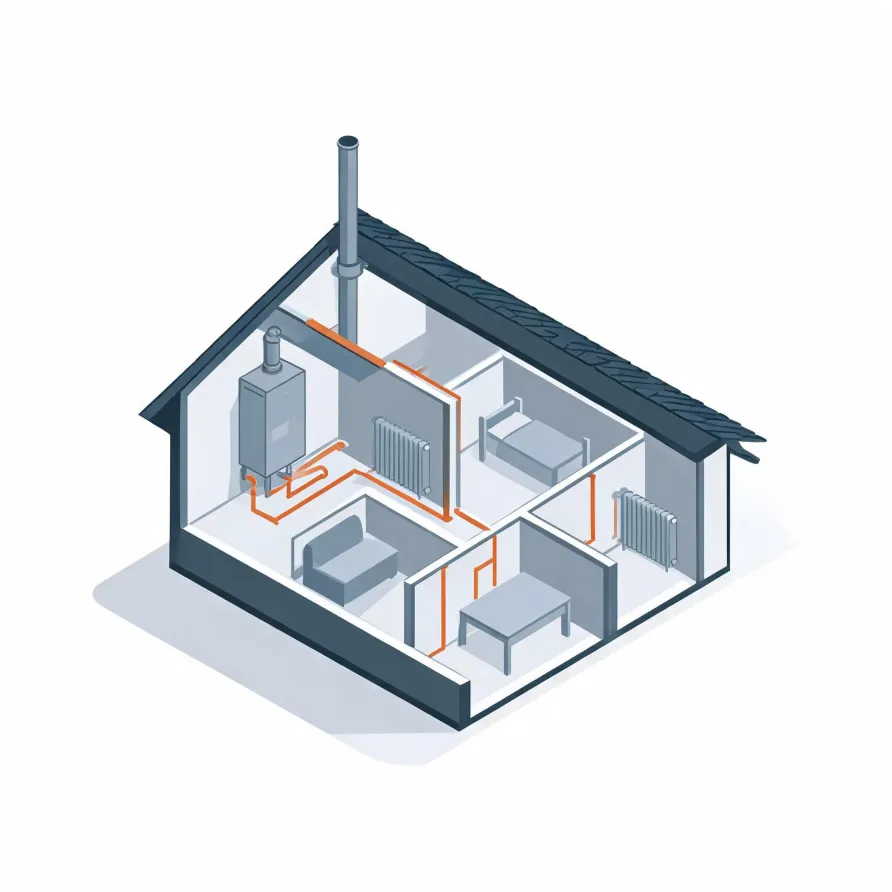
The boiler itself sits in the basement or a utility room and is the piece a contractor goes to first. Inside it, the burner and heat exchanger are the most common sources of trouble: the burner can fail to ignite or run unevenly, and a cracked heat exchanger lets combustion gases leak where they should not go.
From the boiler, pipes carry hot water to radiators or radiant floor loops throughout the house, and a circulator pump keeps that water moving. The expansion tank, pressure relief valve, and aquastat all sit close to the boiler and each one has a specific job that, when it fails, shows up as pressure problems, overheating, or uneven heat across the house.
The drawing shows the general layout of a boiler system, and a licensed contractor determines which components apply to the setup in your house.
Get matched in Cook CountyCook County, by the numbers
780 severe weather events were recorded in Cook County, Illinois between 2015 and 2024.
NOAA National Centers for Environmental Information, Storm Events Database, bulk CSV export, events 2015-01-01 through 2024-12-31.Half the homes in Cook County, Illinois were built in 1961 or earlier (2020-2024 ACS 5-year).
U.S. Census Bureau, 2020-2024 American Community Survey 5-Year EstimatesCook County, Illinois holds 2,276,493 housing units (2020-2024 ACS 5-year).
U.S. Census Bureau, 2020-2024 American Community Survey 5-Year EstimatesOwners occupy 57.7% of the occupied homes in Cook County, Illinois (2020-2024 ACS 5-year).
U.S. Census Bureau, 2020-2024 American Community Survey 5-Year EstimatesBoiler & HVAC Repair Rules on Record for Cook County, Illinois1 sourced standards & codes
Licensing and Legal Requirements in Cook County, Illinois
Illinois leaves HVAC licensing to the municipality: state law lets the corporate authorities of each city or village examine, license and regulate heating, air conditioning and refrigeration contractors, and caps the licence fee they may charge at $50 — so who licenses you depends on the town you work in.
Severe Weather Events in Cook County
Extreme weather puts real stress on boiler systems, cycling them hard through temperature swings they were not sized to ignore. How often that happens in Cook County shapes how much repair work local boilers actually need.
780 severe weather events, 2015–2024. Source: NOAA National Centers for Environmental Information, Storm Events Database.