Tell us about the job
Takes about a minute. No obligation.
A contractor sizing up a boiler repair in Lawrence County works through the usual suspects first: how old the heat exchanger is, whether the system has been serviced, and how the original installation was done. 62 severe weather events were recorded in Lawrence County, Illinois between 2015 and 2024. At that rate, severe weather is an occasional fact of life here, not a chronic mechanical load, and it rarely explains why a boiler has stopped working or started losing pressure. What a contractor finds inside the unit, and what the service history shows, carries the diagnosis.
Boilers installed when these houses were new have been running a long time, and what a contractor finds once a unit is opened here is often a question of parts availability rather than diagnosis. Half the homes in Lawrence County, Illinois were built in 1963 or earlier (2020-2024 ACS 5-year). A heat exchanger or zone valve from that era may still function until it does not, and the manufacturer's replacement line for it may have been discontinued. That is the variable that shapes the repair bill: whether what the opened unit needs can still be sourced, or whether the path forward is a rebuild with adapted parts.
The Parts of a Boiler a Contractor Checks First
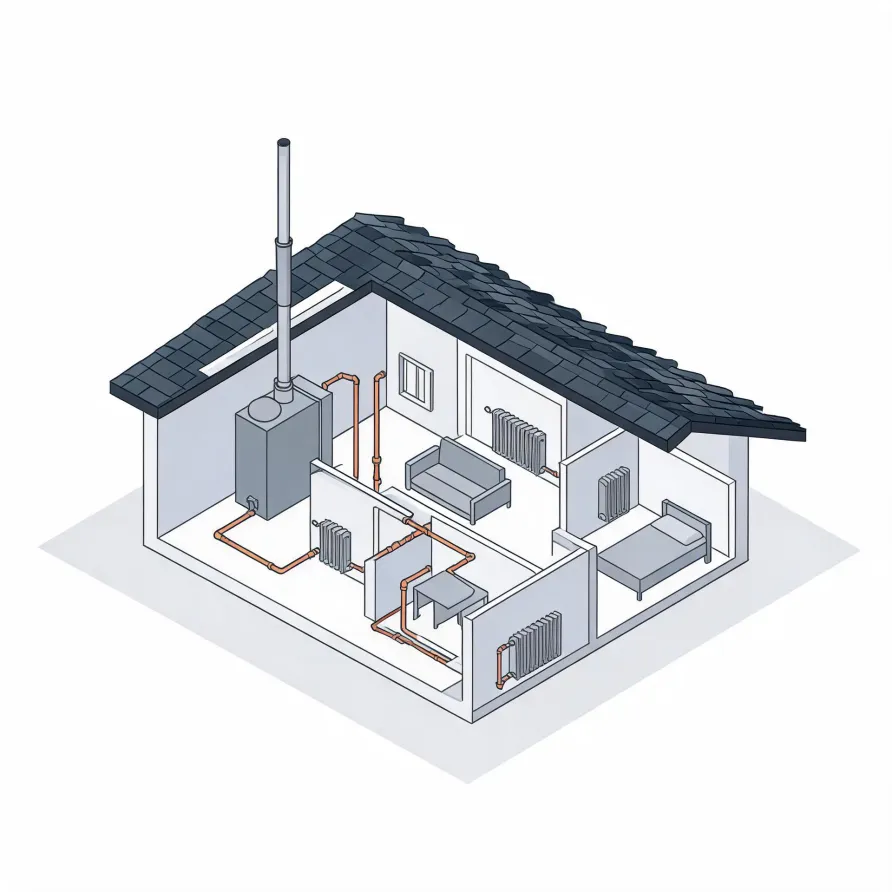
The boiler itself sits in the basement or a utility room and is the piece a contractor goes to immediately when heat stops working or pressure drops. The heat exchanger inside it is where combustion gases transfer warmth to the water, and a crack or buildup there is a common reason the system underperforms. The burner assembly, also inside the unit, is another early suspect when ignition fails or the flame behaves erratically.
From the boiler, water travels through supply pipes to radiators or baseboard units in each room, and the circulator pump is what keeps that water moving. A failed pump means heat stops reaching the living space even when the boiler itself fires fine. The expansion tank, usually mounted near the boiler, absorbs pressure changes in the system, and the pressure relief valve sits close by as a safety measure a contractor checks whenever pressure readings are off.
The drawing shows a general layout of these components, and a licensed contractor determines which of them apply and what condition they are in for your specific home.
Get matched in Lawrence CountyLawrence County, Illinois, by the numbers
62 severe weather events were recorded in Lawrence County, Illinois between 2015 and 2024.
NOAA National Centers for Environmental Information, Storm Events Database, bulk CSV export, events 2015-01-01 through 2024-12-31.Half the homes in Lawrence County, Illinois were built in 1963 or earlier (2020-2024 ACS 5-year).
U.S. Census Bureau, 2020-2024 American Community Survey 5-Year EstimatesLawrence County, Illinois holds 6,407 housing units (2020-2024 ACS 5-year).
U.S. Census Bureau, 2020-2024 American Community Survey 5-Year EstimatesOwners occupy 71.8% of the occupied homes in Lawrence County, Illinois (2020-2024 ACS 5-year).
U.S. Census Bureau, 2020-2024 American Community Survey 5-Year EstimatesBoiler Repair Rules on Record for Lawrence County, Illinois1 codes, standards & regs
Licensing and Legal Requirements in Lawrence County, Illinois
Illinois leaves HVAC licensing to the municipality: state law lets the corporate authorities of each city or village examine, license and regulate heating, air conditioning and refrigeration contractors, and caps the licence fee they may charge at $50 — so who licenses you depends on the town you work in.
Severe Weather Events in Lawrence County
Weather puts work on heating equipment. Hard conditions drive pressure swings, cycling stress, and heat demand that add up over time, and what that load looks like in Lawrence County shapes how local boilers wear.
62 severe weather events, 2015–2024. Source: NOAA National Centers for Environmental Information, Storm Events Database.