Tell us about the job
Takes about a minute. No obligation.
A contractor quoting a boiler repair in Stark County has to work out what actually drove the failure before they can price the job correctly. 50 severe weather events were recorded in Stark County, Illinois between 2015 and 2024. At that rate, severe weather is an event rather than a constant pressure on equipment, which means a struggling heat exchanger or a corroded valve is more likely to trace back to deferred maintenance or original installation quality than to storm load. That changes what a contractor looks at first: burner condition, flue integrity, and service history carry more diagnostic weight here than weather-related wear.
Boilers in housing this old carry a history that shows up the moment a contractor opens the unit. Half the homes in Stark County, Illinois were built in 1956 or earlier (2020-2024 ACS 5-year). A heat exchanger that has run through that many seasons may show fatigue, corrosion, or hairline cracking that nothing on the outside suggests, and the distribution piping connected to it can tell a different story from what the thermostat readings do. Whether a repair is straightforward or involves sourcing parts for a system that predates current manufacturing lines depends on what that inspection finds, not on what the house looks like from the street.
The Parts of a Boiler a Contractor Checks First
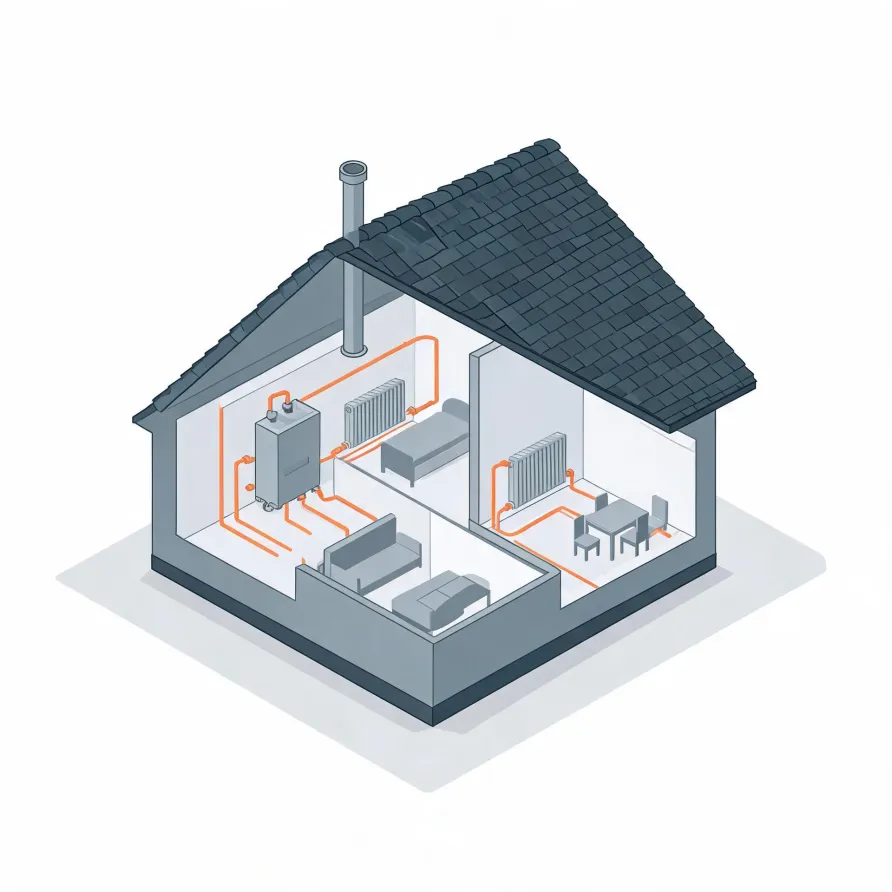
The boiler itself sits in the basement or a utility room and is the heart of the system: it heats water and pushes it out to the rest of the house. When heat stops reaching a room or the system short-cycles, the contractor starts here, checking the heat exchanger, burner, and pressure vessel for the source of the fault.
From the boiler, pipes carry hot water to radiators or baseboard units posted throughout the living spaces, then return cooled water back to be reheated. The circulator pump, expansion tank, and zone valves all sit along those pipe runs and are each a point a contractor will examine when flow or distribution is the problem.
The drawing shows a typical boiler layout, and a licensed contractor determines which components apply to your specific system.
Get matched in Stark CountyStark County by the numbers
50 severe weather events were recorded in Stark County, Illinois between 2015 and 2024.
NOAA National Centers for Environmental Information, Storm Events Database, bulk CSV export, events 2015-01-01 through 2024-12-31.Half the homes in Stark County, Illinois were built in 1956 or earlier (2020-2024 ACS 5-year).
U.S. Census Bureau, 2020-2024 American Community Survey 5-Year EstimatesStark County, Illinois holds 2,573 housing units (2020-2024 ACS 5-year).
U.S. Census Bureau, 2020-2024 American Community Survey 5-Year EstimatesOwners occupy 80.1% of the occupied homes in Stark County, Illinois (2020-2024 ACS 5-year).
U.S. Census Bureau, 2020-2024 American Community Survey 5-Year EstimatesCodes & Standards Governing Boiler Repair in Stark County, Illinois1 sourced rules and standards
Licensing and Legal Requirements in Stark County, Illinois
Illinois leaves HVAC licensing to the municipality: state law lets the corporate authorities of each city or village examine, license and regulate heating, air conditioning and refrigeration contractors, and caps the licence fee they may charge at $50 — so who licenses you depends on the town you work in.
Weather Stress on Heating Systems in Stark County
Hard weather puts hours on boilers that mild winters never would. Repair demand in Stark County tracks directly with what the climate asks of the equipment, which is why local contractors see patterns that out-of-area services do not.
50 severe weather events, 2015–2024. Source: NOAA National Centers for Environmental Information, Storm Events Database.