Tell us about the job
Takes about a minute. No obligation.
A boiler that stops working in Cumberland County almost certainly failed for reasons a contractor can find inside the unit: corroded fittings, a worn circulator pump, a heat exchanger that was never flushed. 35 severe weather events were recorded in Cumberland County, Illinois between 2015 and 2024. At that rate, severe weather is an event in this county, not a constant. A contractor quoting a boiler repair here will look first at service history and component age, because those are what drive failures in an area where the weather puts relatively little on the system.
Boiler systems in houses this old often outlast the parts supply built around them. Half the homes in Cumberland County, Illinois were built in 1970 or earlier (2020-2024 ACS 5-year). A contractor opening a boiler here may find heat exchangers, burner assemblies, or zone valves whose manufacturers have merged, rebranded, or simply stopped making that line. When a part is still available, the repair is straightforward. When it is not, the scope changes: the contractor is sourcing from salvage, finding a cross-compatible substitute, or advising on a different path entirely. That determination comes from what is inside the unit, not from the house's age on its own.
The Parts of a Boiler a Contractor Checks First
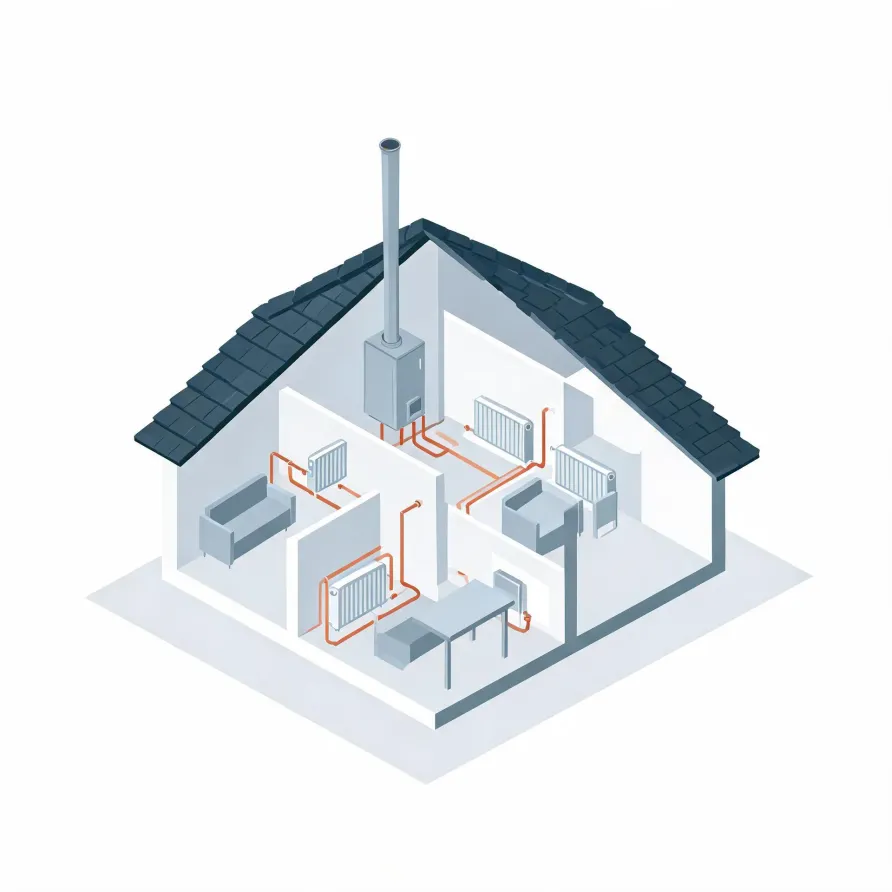
The boiler itself sits in the basement or utility room and is the piece a contractor goes to first. It heats water and pushes it through the system. When a boiler is short-cycling, leaking, or failing to reach temperature, the fault often traces back to the heat exchanger, the burner, or the pressure vessel inside that unit.
Radiators or baseboard convectors sit throughout the living space and release heat into each room. The circulator pump, expansion tank, and relief valve all work alongside the boiler, usually within a few feet of it. A stuck pump, a waterlogged expansion tank, or a weeping relief valve each produce their own symptoms and point a contractor toward different repairs.
The drawing shows a typical boiler layout, and a licensed contractor determines which components and conditions apply to your specific house.
Get matched in Cumberland CountyCumberland County by the numbers
35 severe weather events were recorded in Cumberland County, Illinois between 2015 and 2024.
NOAA National Centers for Environmental Information, Storm Events Database, bulk CSV export, events 2015-01-01 through 2024-12-31.Half the homes in Cumberland County, Illinois were built in 1970 or earlier (2020-2024 ACS 5-year).
U.S. Census Bureau, 2020-2024 American Community Survey 5-Year EstimatesCumberland County, Illinois holds 4,726 housing units (2020-2024 ACS 5-year).
U.S. Census Bureau, 2020-2024 American Community Survey 5-Year EstimatesOwners occupy 84.2% of the occupied homes in Cumberland County, Illinois (2020-2024 ACS 5-year).
U.S. Census Bureau, 2020-2024 American Community Survey 5-Year EstimatesBoiler Repair Rules and Codes for Cumberland County, Illinois1 sourced standards and regulations
Licensing and Legal Requirements in Cumberland County, Illinois
Illinois leaves HVAC licensing to the municipality: state law lets the corporate authorities of each city or village examine, license and regulate heating, air conditioning and refrigeration contractors, and caps the licence fee they may charge at $50 — so who licenses you depends on the town you work in.
Severe Weather Events in Cumberland County
Hard weather puts hours on a boiler faster than age alone does. Repair demand in Cumberland County tracks local conditions, and that makes weather history part of understanding what the equipment here is up against.
35 severe weather events, 2015–2024. Source: NOAA National Centers for Environmental Information, Storm Events Database.