Tell us about the job
Takes about a minute. No obligation.
A contractor called out to repair a boiler in Hancock County has to settle one question before quoting anything: what actually caused the failure. 138 severe weather events were recorded in Hancock County, Illinois between 2015 and 2024. That is a real load on equipment here, but it sits at a level where severe weather is a background condition rather than the dominant one, and most failures a contractor opens up trace back to age, neglected maintenance, or an original install that was never quite right. A homeowner who assumes a rough season explains a cracked heat exchanger may be looking past the real cause.
Boilers in houses this old have often outlasted the parts catalogs written for them. Half the homes in Hancock County, Illinois were built in 1964 or earlier (2020-2024 ACS 5-year). A contractor opening a boiler here finds heat exchangers, expansion tanks, and zone valves sized for equipment generations back, and the first real question is whether those parts are still made at all. If they are not, the repair decision shifts: a like-for-like fix is off the table, and what the contractor prices instead is a different scope entirely.
The Parts of a Boiler a Contractor Checks First
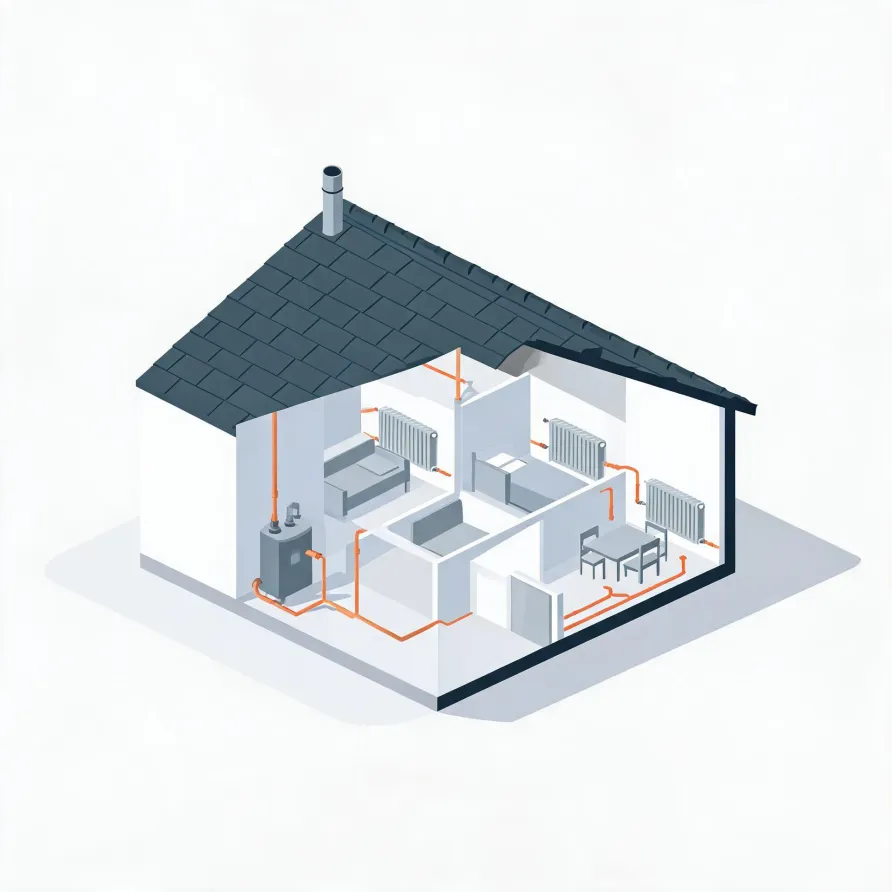
The boiler itself sits in the basement or a mechanical room and is the piece a contractor goes to first. It heats water and pushes it through the system. When a boiler is short-cycling, leaking, or failing to reach temperature, the issue often traces back to the heat exchanger, the burner assembly, or the pressure relief valve inside or directly on the unit.
From the boiler, supply pipes carry hot water to radiators or baseboard convectors in each room, then return pipes bring the cooled water back. The circulator pump, mounted on those pipes, is what moves the water through the loop, and the expansion tank nearby absorbs pressure changes as the water heats and cools. A contractor checks the pump, the tank, and the pipe connections when the boiler itself looks sound.
The drawing shows a typical boiler layout, and a licensed contractor determines which parts apply and what needs attention in your specific home.
Get matched in Hancock CountyHancock County by the numbers
138 severe weather events were recorded in Hancock County, Illinois between 2015 and 2024.
NOAA National Centers for Environmental Information, Storm Events Database, bulk CSV export, events 2015-01-01 through 2024-12-31.Half the homes in Hancock County, Illinois were built in 1964 or earlier (2020-2024 ACS 5-year).
U.S. Census Bureau, 2020-2024 American Community Survey 5-Year EstimatesHancock County, Illinois holds 8,938 housing units (2020-2024 ACS 5-year).
U.S. Census Bureau, 2020-2024 American Community Survey 5-Year EstimatesOwners occupy 81.3% of the occupied homes in Hancock County, Illinois (2020-2024 ACS 5-year).
U.S. Census Bureau, 2020-2024 American Community Survey 5-Year EstimatesBoiler Repair Rules & Standards on Record for Hancock County, Illinois1 sourced rules and standards
Licensing and Legal Requirements in Hancock County, Illinois
Illinois leaves HVAC licensing to the municipality: state law lets the corporate authorities of each city or village examine, license and regulate heating, air conditioning and refrigeration contractors, and caps the licence fee they may charge at $50 — so who licenses you depends on the town you work in.
Severe Weather Events in Hancock County
Hancock County's weather puts real stress on boilers over time. That workload shapes what repairs come up and how often a system needs attention, which is why local service history matters.
138 severe weather events, 2015–2024. Source: NOAA National Centers for Environmental Information, Storm Events Database.