Tell us about the job
Takes about a minute. No obligation.
A boiler contractor quoting in Livingston County has to know what the local climate actually asks of a heating system before settling on equipment size or specifying components. 104 severe weather events were recorded in Livingston County, Illinois between 2015 and 2024. That puts this area near the middle of the national range, which means the weather load is real and steady without being exceptional. A boiler sized and installed for conditions here does not need to be over-engineered, but the install still has to be correct for the soil, the structure, and the local code, because those local variables shape the job more than the weather does.
Piping runs, radiator placement, and distribution layouts in older Livingston County houses were designed for whatever was original to the building, and a boiler replacement does not automatically inherit a clean path forward. Half the homes in Livingston County, Illinois were built in 1961 or earlier (2020-2024 ACS 5-year). That history means a contractor has to read the existing distribution system before anything else on a boiler job: whether the piping routes can carry the new unit's output, where the system dead-ends, and whether the existing configuration needs to be reworked or can stay. The equipment choice follows from that assessment.
What Gets Installed With a New Boiler
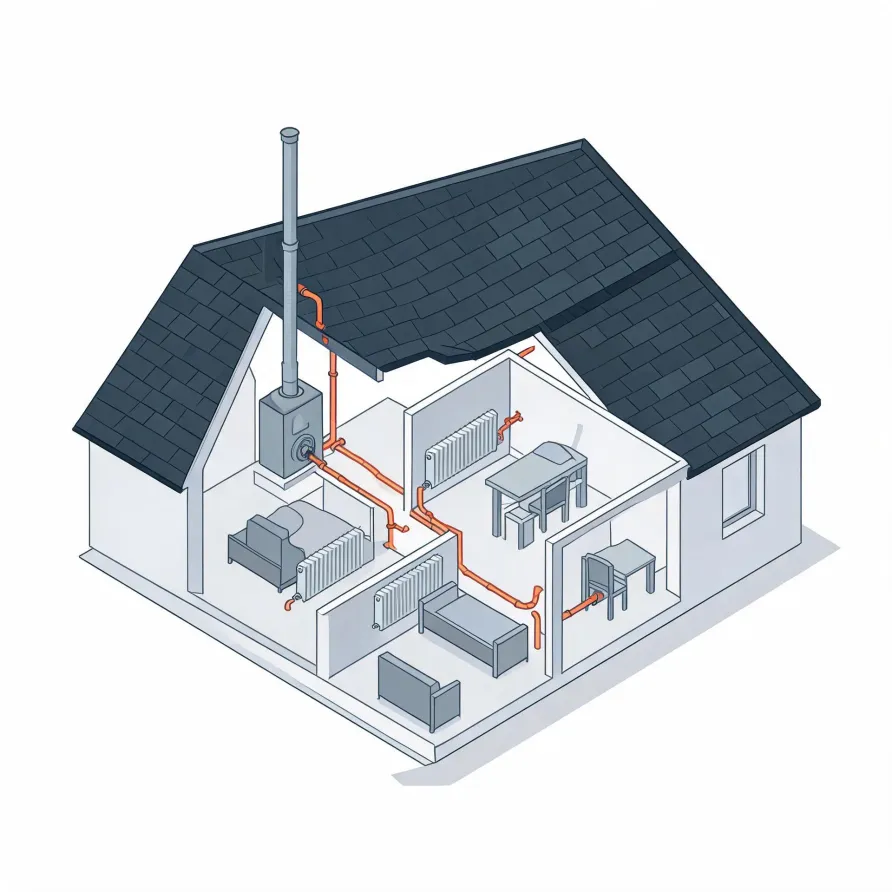
The boiler itself sits in a mechanical room, basement, or utility closet and is the unit a homeowner notices first when they walk into that space. A contractor mounts it against a wall or on the floor, connects it to the home's gas or oil supply, and ties it into the flue or exhaust vent that runs to the outside.
From the boiler, supply pipes carry hot water to radiators or baseboard units in each room, and return pipes bring the cooled water back. A circulator pump, typically mounted on those pipes near the boiler, keeps the water moving through the loop. The expansion tank and pressure relief valve sit close to the boiler as well, managing pressure as the water heats and cools.
The drawing shows the general layout of these components, and a licensed contractor determines exactly what applies to this particular house.
Get matched in Livingston CountyLivingston County, by the numbers
104 severe weather events were recorded in Livingston County, Illinois between 2015 and 2024.
NOAA National Centers for Environmental Information, Storm Events Database, bulk CSV export, events 2015-01-01 through 2024-12-31.Half the homes in Livingston County, Illinois were built in 1961 or earlier (2020-2024 ACS 5-year).
U.S. Census Bureau, 2020-2024 American Community Survey 5-Year EstimatesLivingston County, Illinois holds 15,930 housing units (2020-2024 ACS 5-year).
U.S. Census Bureau, 2020-2024 American Community Survey 5-Year EstimatesOwners occupy 74.3% of the occupied homes in Livingston County, Illinois (2020-2024 ACS 5-year).
U.S. Census Bureau, 2020-2024 American Community Survey 5-Year EstimatesCodes & Standards Governing Boiler Installation in Livingston County, Illinois1 sourced rules and standards
Licensing Rules for Livingston County, Illinois
Illinois leaves HVAC licensing to the municipality: state law lets the corporate authorities of each city or village examine, license and regulate heating, air conditioning and refrigeration contractors, and caps the licence fee they may charge at $50 — so who licenses you depends on the town you work in.
Severe Weather Events in Livingston County
Weather puts direct load on heating equipment, and in Livingston County that load shapes how hard a boiler works and how long its components last. A system sized and installed for local conditions holds up where a generic one falls short.
104 severe weather events, 2015–2024. Source: NOAA National Centers for Environmental Information, Storm Events Database.