Tell us about the job
Takes about a minute. No obligation.
A contractor quoting a boiler installation in Pope County has to work out what the system will actually be asked to carry year to year. 60 severe weather events were recorded in Pope County, Illinois between 2015 and 2024. That count puts the area at the quieter end of what Illinois counties see, which means the dominant stresses on a heat exchanger and its controls are corrosion, scale buildup, and long cycling patterns rather than repeated weather punishment. The installer's sizing decisions and the quality of the pipework and flue connections are what determine how the system holds up, and those answers come from the house, not from the forecast.
Ductwork in a house carries the specifics of the system it was built for, and those specifics do not automatically match a modern boiler's output or connections. Half the homes in Pope County, Illinois were built in 1986 or earlier (2020-2024 ACS 5-year). A contractor quoting a new installation here has to open the runs, check the dimensions, and decide whether what is already in the house will carry the new load or has to be reworked first. That answer shapes the scope of the job before any equipment gets priced.
What Gets Installed With a New Boiler
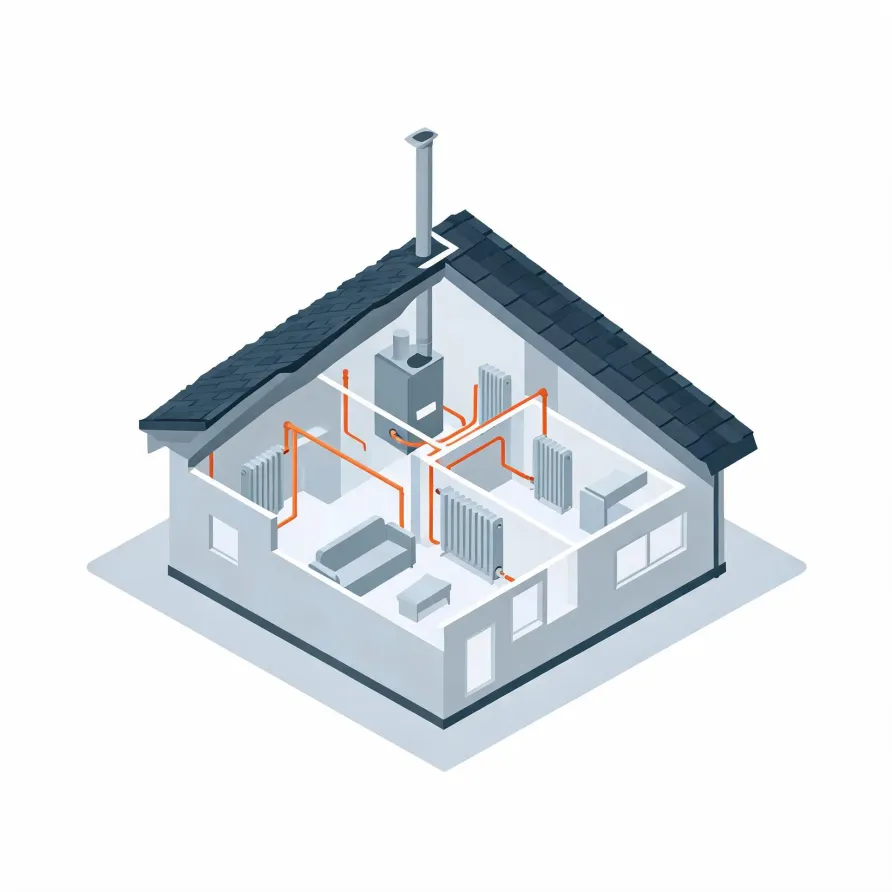
The boiler itself sits in the basement or a utility room and is the heart of the installation. Attached to it are the burner assembly, the heat exchanger, and the expansion tank, each mounted directly on or beside the unit. A pressure relief valve and the circulator pump are also fixed to the boiler before any piping runs through the house.
From the boiler, supply and return pipes run through the walls and floors to the heat emitters, which are either radiators standing against the walls in each room or radiant tubing laid beneath the floor. The thermostat mounts on an interior wall and tells the circulator when to move water through the loop. A backflow preventer and shutoff valves go in at the boiler connection points so the system can be isolated for future service.
The drawing shows a general layout of these components, and a licensed contractor determines exactly what applies to this house.
Find a contractor in Pope CountyPope County by the numbers
60 severe weather events were recorded in Pope County, Illinois between 2015 and 2024.
NOAA National Centers for Environmental Information, Storm Events Database, bulk CSV export, events 2015-01-01 through 2024-12-31.Half the homes in Pope County, Illinois were built in 1986 or earlier (2020-2024 ACS 5-year).
U.S. Census Bureau, 2020-2024 American Community Survey 5-Year EstimatesPope County, Illinois holds 2,225 housing units (2020-2024 ACS 5-year).
U.S. Census Bureau, 2020-2024 American Community Survey 5-Year EstimatesOwners occupy 86.3% of the occupied homes in Pope County, Illinois (2020-2024 ACS 5-year).
U.S. Census Bureau, 2020-2024 American Community Survey 5-Year EstimatesBoiler Installation Rules for Pope County, Illinois1 codes and standards
Licensing and Legal Requirements in Pope County, Illinois
Illinois leaves HVAC licensing to the municipality: state law lets the corporate authorities of each city or village examine, license and regulate heating, air conditioning and refrigeration contractors, and caps the licence fee they may charge at $50 — so who licenses you depends on the town you work in.
Severe Weather Events in Pope County
Boiler systems work hardest when outdoor conditions push indoor temperatures to their limits, and how hard that happens here is shaped by what this county's weather actually delivers. That load profile is a local fact, and it bears directly on what size and type of equipment a contractor will specify for a home in Pope County.
60 severe weather events, 2015–2024. Source: NOAA National Centers for Environmental Information, Storm Events Database.